Abbot Joachim of Fiore is among the most innovative and nonconformist medieval figures, and for this reason, he still arouses academic interest today.
Life
Born in Celico in 1135, he was educated in Cosenza and continued his studies in Palermo, a place where different cultures and religions coexisted. Struck by a mystical crisis, he spent an entire Lent in Palestine, on Mount Tabor, where he received the gift of Intelligence, the ability to scrutinize the Sacred Mysteries and understand the meaning of the Scriptures. He became a Cistercian Abbot of the Abbey of Santa Maria di Corazzo in Carlopoli, then decided to establish a new and even more rigorous Order than the Cistercians: the Florense Order. He identified a place in Sila, among the mountains understood in a biblical sense as the place where it is possible to understand God's plan in history. Joachim named this place Jure, flower, and founded the Protomonastery there. He died on March 30, 1202, in San Martino di Giove in the locality of Canale in Pietrafitta, in the province of Cosenza.
Thought
Abbot Joachim, "endowed with a prophetic spirit" as his contemporary Dante Alighieri described him, is among the most important medieval figures for theological and academic studies still carried out today.
Giuseppe Riccardo Succurro, President of the International Center for Joachimite Studies, explains that "the Abbot was a theologian of history, a biblical exegete, a monastic reformer." In particular, Joachim of Fiore was the "Monk who freed men from the terror of History." "In the centuries following the Year 1000, people were still terrified by the possibility of the end of the World," explains Succurro. "Joachim, however, developed a complex theory according to which, as time approaches the end, History becomes lighter and social structures more just. The Age preceding the Last Judgment will thus be characterized by peace, bliss, and justice, with a Church freed from the trappings of temporal power. The second coming of Christ, for Joachim, is not laden with terror but with Hope."
The Liber Figurarum
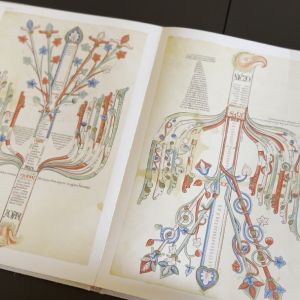
Among Joachim of Fiore's most important works is the Liber Figurarum, a collection of images through which he expresses and represents his theological thought. The figures illustrate the complex Joachimite prophetic thought based on Trinitarian theology.
One image in particular, the Trinitarian Circles, represents the concatenation between the Age of the Father, Creator of Nature (blue), the Age of the Son, descended from Heaven (green), and the Age of the Holy Spirit, which is Love (red). This figure was useful to Dante Alighieri himself in describing the Trinity in the 33rd Canto of Paradise in his Divine Comedy.
The Joachimite Path
The Joachimite Path is also dedicated to Joachim of Fiore, retracing the salient stages of the Abbot's life between the Sila National Park and the provinces of Cosenza and Catanzaro. It starts from the Bastion of Malta near Sant'Eufemia to the Abbey of Santa Maria di Corazzo in Carlopoli in the Catanzaro area, then reaches the shores of Lake Arvo and finally San Giovanni in Fiore.
The international importance of Joachim of Fiore's figure is also evident from the 2024 film "The Monk Who Conquered the Apocalypse" by Jordan River, an Italian-American production. The director's main intent is not so much to retrace his existence as to spread his mystical-philosophical investigation as widely as possible.