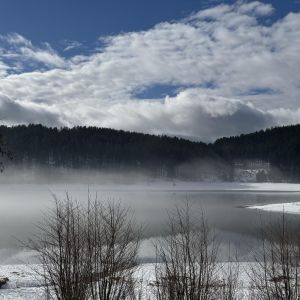
The Sila National Park is located in the heart of Calabria, spanning the provinces of Cosenza, Crotone, and Catanzaro, which divide the Park into three areas: Sila Grande, Sila Greca, and Sila Piccola. The symbol of the Park is the wolf, "bad only in fairy tales," and here you can breathe the cleanest air in Europe.
Nature
The Nature of Sila is enchanting due to its richness in animal and plant species. Deer, ibex, roe deer, fallow deer; the wolf; the black squirrel, the eagle are just some of the wildlife species that have taken refuge in the Sila mountains or were brought here by humans to prevent their extinction.
Among the wooded areas, you will find beech, oak, chestnut, and pine trees. The beech forests, in particular, are the stars of the Sila autumn when the leaves turn crimson, attracting tourists and photography enthusiasts. The phenomenon of Sila foliage has also captivated National Geographic magazine thanks to the shots by photographer Giuseppe Intrieri.
The highest peak of Sila, Mount Botte Donato, is the favorite destination for winter tourism due to the abundance of ski lifts and slopes, while the numerous lakes are preferred in the warmer seasons. Arvo, Ampollino, and Cecita are artificial basins that offer relaxation and adventure. They can be explored by boat, kayak, or water bike; from the shores, trekking, horseback riding, and cycling routes start.
Visitor Centers
Those who choose Sila cannot miss exploring the Park's Visitor Centers, including "Antonio Garcea" and "Cupone." Here you will find the natural history museum, the geological garden, the botanical garden, but above all, the wildlife observatories where you can meet animals in semi-freedom up close.
The Giants of Sila
In the locality of Croce di Magara, you will find the Fallistro Nature Reserve or "The Giants of Sila," a protected natural area hosting 56 specimens of centuries-old larch pines of majestic dimensions: up to 45-50 meters in height with a diameter of about two meters. Walking among the Giants, you will find hollow trunks that can host groups of people; trunks "embraced" and intertwined together almost to form a centuries-old bond; trunks divided in two like those who take different paths starting from common roots. The Italian Environmental Fund takes care of them, and you can choose between solo excursions or guided tours.
The Sila Train
Traveling on the Sila Train is a bit like traveling back in time through the puffs of the steam locomotive. On the Sila Plateau lies the highest "narrow gauge" line in Europe, over 1400 meters above sea level. The FCL 353 steam locomotive, built in 1925 by the August Borsig company in Berlin, is today the last of its kind. The journey, between Camigliatello and San Nicola Silvana Mansio, crosses an enchanted landscape of woods and clearings and becomes particularly scenic in winter when the snow splashes to the sides of the locomotive as the train passes. The journey is designed as a real experience and is enlivened by costume performances, live music, and tastings.
History
The history of the Sila National Park is not only preserved in the woods, in the ruins of castles and fortifications but also in the heart of the villages where ancient crafts continue to be practiced by artisans dedicated to their work. San Giovanni in Fiore, Longobucco, Spezzano della Sila, and Acri are emblematic of this.
These are the towns touched by the trails that lead to the discovery of illustrious historical figures such as Blessed Angelico of Acri, Saint Francis of Paola, and Joachim of Fiore.
Typical gastronomy is also sought after: Caciocavallo Silano DOP; porcini mushrooms; Sila IGP potatoes to be cooked strictly 'mpacchiusa.
The Sila National Park is a wonder to visit in every season. It offers fun for families, sports and adventure, but also romantic walks on foot and horseback, making it the ideal destination for every type of tourism.